// transmission -
🪦 Search Is Dead; Long Live Search
I've been working & advising in search for 15 years.
A lot has changed in that time.
And if you've been here a while, you know I've been keeping you updated on every change.
In May 2023, I wrote to you about Google's SGE (Search Generative Experience) and said, "Google is fundamentally changing search... This technology has the potential to revolutionize the way we search for information, but let's be honest, it will." Read that edition →
A year later, in May 2024, I sent an edition titled "Google just changed search forever." I warned you that SEO was shifting from chasing keywords to chasing quality, because AI answers were appearing right at the top of results. Read that edition →
By February 2026, the reality hit hard. I sent you the "Google Took 58% from Us" edition, showing how top-ranked pages were surrendering more than half their clicks whenever an AI Overview appeared. Read that edition →
And now, after Google I/O 2026 last week, the transition is complete.
The simple transaction of typing a keyword and getting a list of blue links is officially dead.
RIP. 🪦
Google Search is no longer an index of the web.
It's an AI agent that also shows you web links.
This is the biggest architectural shift in 25 years, and I have all the feels about it.
And AI Mode is half way through it's multi-week global roll out that will be a fundamental change to how the world gets their information on the #1 most visited website on the internet.
If you run a business, create content, or sell anything online, the ground just shifted under your feet.
Let's look at the 6 pillars of what actually happened and why you can't ignore this.
Before we get into it…
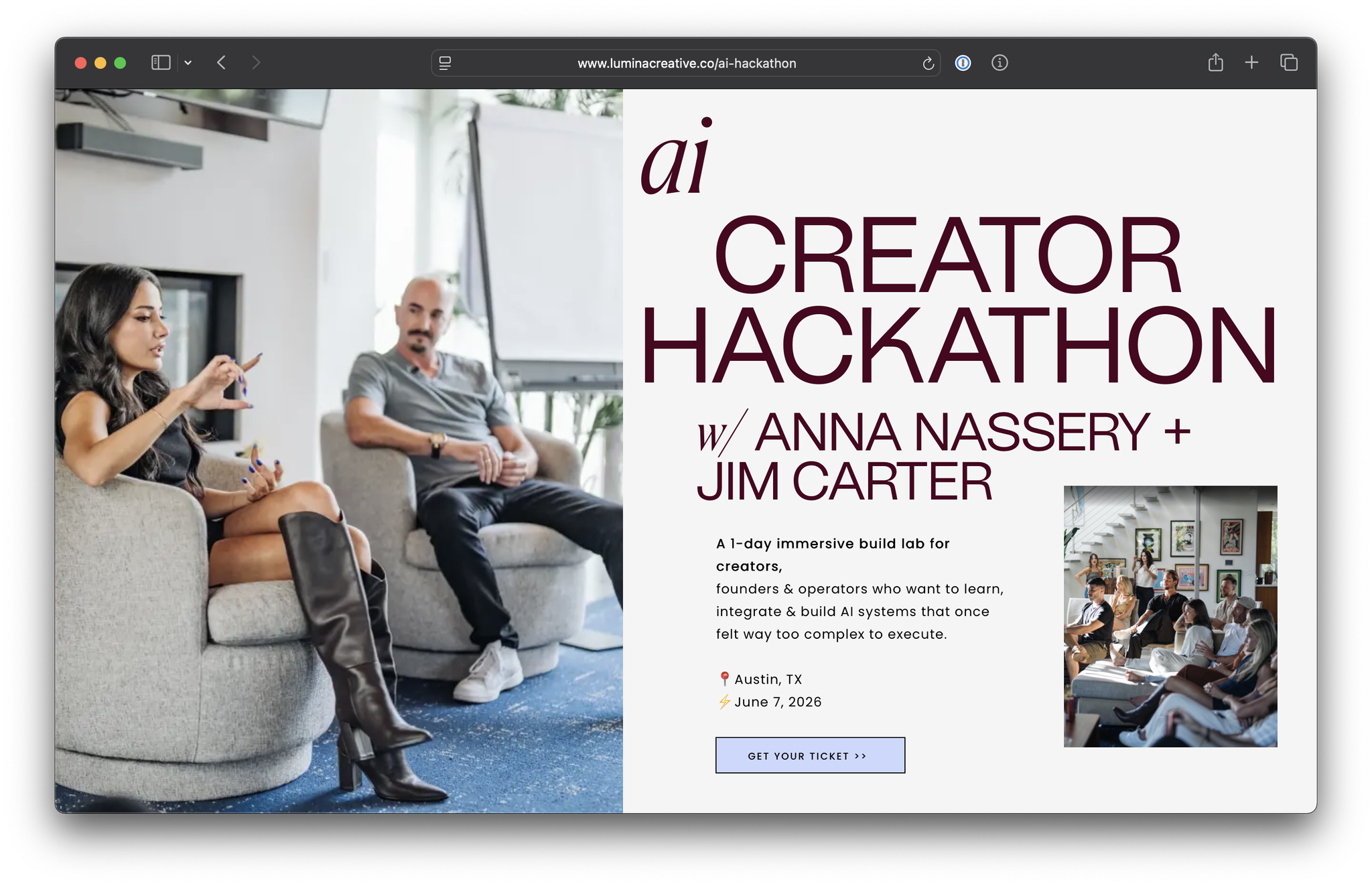
I'm co-running a hands-on AI Hackathon with Anna Nassery for people who want to actually build something useful with AI.
And it's happening in-person, in Austin, TX - Sunday June 7th!
You'll spend a day building inside a collaborative pod with other founders. I'll be there to support the technical side, while Anna supports you with the strategy.
We'd love to have you join our intentionally small group here. 🔗
🔍 1. The End of the Simple Input Field
Google just replaced the search box with an intelligent, multimodal interface powered by Gemini 3.5 Flash.
Key Facts
- AI Mode is the Default - You can now have ongoing conversational back-and-forth with search, complete with follow-up questions.
- Built for Speed - Gemini 3.5 Flash is the new global default, built specifically for multi-hour agentic pipelines.
The old search box was a dumb input field.
It captured text and returned a ranked list.
The new box anticipates your intent. It suggests how to formulate questions more precisely and treats each query as the beginning of a conversation rather than a transaction.
Yep. You read that right.
You're now having a conversation with Google.
And people are using it.
AI Mode crossed 1 billion monthly active users in just one year and queries are doubling every quarter.
🖱️ 2. The Zero-Click Reality
The open web's relationship with Google is fundamentally resetting.
Key Facts
- 69% Zero-Click Rate - Nearly 70% of searches now end without a click to any website.
- 1% Citation Clicks - Only 1% of users who see an AI Overview actually click a link cited in the summary.
For 25 years, the deal was simple: Google crawls your content, shows it, and you get the traffic.
That deal is long gone.
If you write informational or evergreen content, the AI is summarizing it and keeping the user on Google.
Breaking news is still getting clicks, but if you're answering "how to" or "what is," you're losing traffic fast.
The traditional SEO playbook is increasingly obsolete.
The new game isn't ranking for clicks. It's visibility and favorable framing within AI-generated summaries.
It's about becoming a cited authority source.
And we need to rethink everything we used to know about keywords and traffic.
🤖 3. Search Agents Working 24/7
Information Agents are being deployed into Google's infrastructure and can scan blogs, news sites, social posts, and real-time data streams and push synthesized, actionable updates to users when relevant events occur.
Key Facts
- Always On - Agents operate continuously in the background, 24/7, without the user needing to ask again.
- Actionable Updates - Each update includes the ability to take action, not just inform.
Users no longer have to actively search for information.
The information finds them when it's relevant.
📖 4. Agentic Booking
Google is expanding agentic booking capabilities to a wide range of local services.
Key Facts
- AI Calls Businesses - For select categories, Search can call businesses on the user's behalf, handling the conversation autonomously.
- Direct Booking Links - Search assembles pricing and availability across providers with direct booking links.
You don't just search for a "private karaoke room for six on a Friday night."
The AI agent finds the spot, checks availability, and books it for you.
🛒 5. The Universal Cart
Google introduced the Universal Cart - a single shopping cart aggregated across all Google surfaces (Search, YouTube, Gmail) and supported retailers.
Key Facts
- Single Cart - Aggregated across all Google surfaces and supported retailers.
- AI Purchasing - Allows AI agents to complete purchases on a user's behalf.
AI agents can now complete purchases on your behalf inside Google.
The checkout experience is no longer yours to own.
📋 6. Universal Commerce Protocol (UCP)
UCP standardizes the entire transaction process into an open, interoperable protocol.
Key Facts
- Infrastructure Layer - Positions Google as the connective layer between consumers, retailers, and payment systems, co-built with Shopify, Amazon, Stripe, Walmart, and others.
- Open Standard - Described as "TCP/IP for commerce" - not owned by any one entity.
Google is no longer just in the discovery moment.
It's embedded in the transaction itself.
Here's what I keep coming back to.
We are staring down a traffic cliff, and it's hitting right now.
Top-ranking pages are seeing 58%+ drops in clicks.
Think about a kiosk standing in front of your restaurant handing out free samples mixed with five competitors' food.
People get a tasted of what they need and more than half walk away feeling satisfied not needing to come in for a full meal.
No visit.
No chance to show them what you're all about.
If you still think SEO works like it did three years ago, you're already behind.
The game has shifted from "rank and wait for clicks" to "become a source AI wants to cite."
That is the biggest change publishers and creators need to understand right now.
Everything else flows from that.
But there is a deeper, more existential threat hidden inside the Universal Commerce Protocol and agentic booking.
You're unfortunately about to lose direct customer relationships.
Right now, when someone buys from you, you own that touchpoint.
The customer sees your site, your brand, your story.
With AI agents handling it all, you become a commodity option in a list.
The agent picks based on price, reviews, and speed. Your brand disappears unless the agent opts to raise it to you.
You can't build loyalty through an intermediary.
And the data: every preference, every hesitation, every buying pattern.. becomes the moat for Google, OpenAI and agents, not you.
So what's the play?
You have to become the thing the agents recommend.
That means:
- an obsessively good product
- unshakeable reviews
- and fastest fulfillment.
You compete to be the obvious choice when an AI sorts options.
But you must also use agents as a distribution channel, not the whole game.
Over the next 2-3 years, we'll see a brutal bifurcation: brands that only exist through agents will collapse, while brands that use agents to expand reach while fiercely protecting their direct relationships will thrive.
This is why even I've started putting massive effort into my own Google Business Page 🔗 where I post just about every day, brand myself, capture reviews and make it as easy as possible to agents to see my AI authority.
^^ side note, it would mean the world to me to have you leave a review if I've added value to your life!
Ask yourself three questions right now:
1️⃣ Where does your traffic come from today, and how much of it relies on answering simple informational questions that an AI can now summarize?
2️⃣ If an AI agent tried to book a service or buy a product from you right now, is your system structured enough for a machine to understand your inventory and pricing?
3️⃣ Are you building authority in places that AI models trust - like YouTube, Reddit, Google Business listings, or high-tier publications - or are you just trying to rank your own blog posts?
✅ Try This, This Week
Open up your analytics and look at your top 10 highest-traffic pages from organic search.
Take the main keyword for each of those pages and run it through Google's AI Mode.
Does your brand show up in the summary?
Does the AI recommend your solution?
If the answer is no, you have your marching orders for the next quarter.
You need to optimize for the engine that's actually answering the questions.
And honestly… this is exactly why I'm running the AI Hackathon.
Because most founders haven’t yet built the AI systems and assets needed to stay visible and competitive in this next phase of the internet.
We’re spending a full day helping you build workflows and actually apply this stuff.
If you’re thinking “I probably need to get ahead of this now,” you’re probably right.
Join me 🔗
// enjoyed.this.transmission
Get the next one in your inbox.
CTRL+ALT+BUILDTM ships every Tuesday - free forever, unsubscribe anytime.
// ps - there's a whole room behind this letter. Meet the community →