🎁 My 2025 AI Wrapped
I prompted my own "AI Wrapped" for 2025 and used it to reflect on where we got things right, where we were early, and what I'm building next.
Notice I didn't say “I coded..” this project?
It's because we no longer have to do everything by hand, or pay someone to get a micro-project live. And there's no better way to teach you other than to show you.
My goal is to help you spot the moves that compound inside your business, not just add another tab to your browser.
So that when you say **“2026 will be my year” **it actually is.
⏮️ Looking Back at My Predictions for 2025
I graded last year’s predictions, pulled the lessons forward, and folded them into everything I build.
One year ago, **I made 5 big calls about where AI was headed. **
You can check it out here 🔗
Let me walk you through what actually happened and why it matters for your business right now.
🖼️ Multimodal AI became the standard ( ✅ called-it )
GPT-4+, Gemini 2+, and other models now see images, hear audio, and read documents all at once as the new normal.
Enterprise buyers now expect this capability as a baseline requirement.
**💿 Specialized AI hardware proved its value **( ✅ called-it )
I predicted we'd see chips built specifically for running AI models, not training them. That's exactly what happened with companies like Groq and their LPU technology.
The demos are honestly stunning when you see how fast they respond.
🎭 AI agents started acting, not just answering ( ✅ called-it )
We moved from chatbots that respond to questions to agents that actually complete tasks.
These digital workers can now plan multi-step processes, use your existing tools, and report back with proof of what they accomplished.
⚖️ Regulations got clearer but stayed fragmented (⏳ not yet )
The EU passed its AI Act into law.
US agencies published guidance on safety and transparency.
Healthcare, finance, and government sectors pushed for clearer rules.
But we still don't have anything close to a global rulebook.
🩺 Medical AI stayed cautious (⏳ not yet )
Hundreds of AI devices got regulatory clearance, especially in radiology. But almost all of them keep doctors in the loop as decision support tools.
Full automation remains rare and tightly controlled.
GPT is now deferring medical answers but is still steerable.
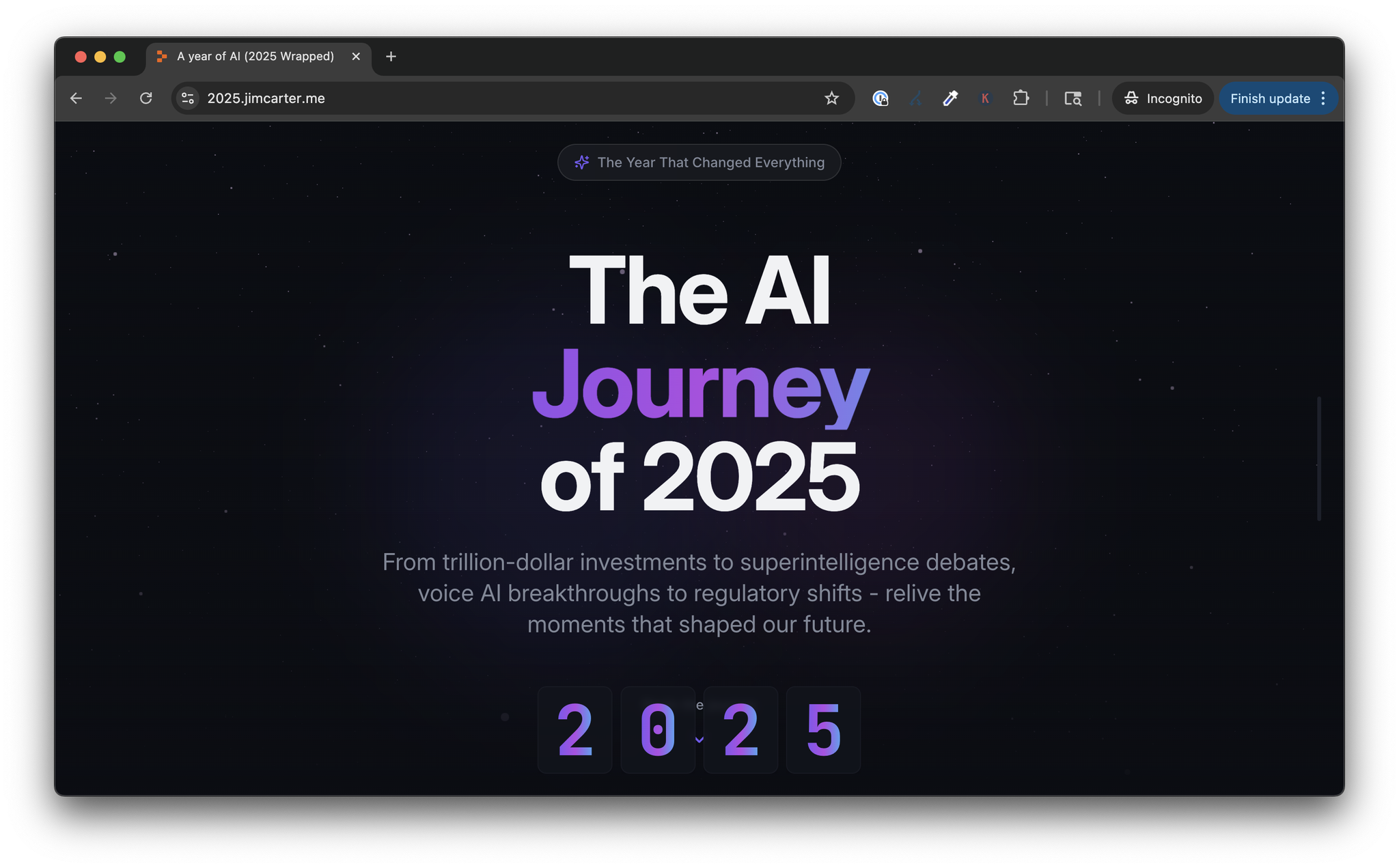
🎧 2025 AI Wrapped
*There are three themes steering the ship. *The Full Site is here 🔗
💻 AI as Core Infrastructure
Time saved becomes the main KPI.
Knowledge bases turn into searchable databases.
Workflows assemble like Lego bricks, then scale across teams.
For me, AI-as-infrastructure means I design for data flows and systems, not for single prompts.
Instead of “I’ll ask ChatGPT when I’m stuck,” I build persistent workflows: lead-qualifying agents, research pipelines, auto‑tagging and summarization of calls, content engines, and more thinking how future-me will use them.
This shift has been huge in my own work because it compounds.
Every new process I work on becomes reusable intellectual infrastructure: the more I build, the faster everything else gets.
👷♀️ AI as New Workers
Niche agents work best with defined charters.
Early wins land in research, content, and customer success.
Managers start budgeting for AI seats the same way they budget for SaaS.
*Thinking in terms of agents forces me to define roles and outcomes, not prompts. *
Instead of “help me write X,” I design an agent whose job is to monitor a pipeline, pull in data, draft content, and trigger human review at the right points.
Most leaders I support will never “use a model” directly; they’ll use an agent that owns a slice of their business process.
That’s why I keep saying “agents are the new workers”: it reframes AI as headcount leverage, not just text assistance.
🔄 Own Your Distribution
Direct answers from chatbots shrink organic search traffic.
Email, community, and audio remain channels you actually control.
One idea splinters into blog posts, reels, and slides with a single click.
What I’ve seen is that the shift in organic traffic isn’t about “SEO is dead” it’s about “the middleman is now an AI.”
AI overviews dramatically reduce click‑through on a lot of queries, and relying on old search patterns is now dangerous.
That’s why, when I talk about future‑proofing, I push towards systems that capture attention, convert it to subscribers or members, and then nurture through channels I control.
AI is a force multiplier here: I use it to summarize, repackage, and personalize content across email, podcasts, blogs, and social without burning out.
Rather than chasing whatever new SEO hack is trending, I’m focused on building robust content machines that keep delivering even as interfaces change.
SEO has changed for good, weather or not we want to accept it.
The new mindset you HAVE to accept is both defensive (protecting the downside) and offensive (creating more consistent growth).
🔮 Glimpse of 2026
Based on everything I've seen and built this year, here's what I expect to be normal by the end of 2026.
1️⃣ Agents become standard teammates
Most teams will run a small stack of specialized agents.
These agents will pass context between each other, not just outputs. They'll live inside the tools you already use.
You'll measure their performance like any team member.
Response time. Accuracy rates. Cost per task. Exception frequency.
Expect 50% - 70% of repetitive tasks to shift to agents, with humans handling judgment calls and exceptions.
2️⃣ Search becomes action
Search will shift from "find me links" to "get me the answer and complete the task."
Browsers and work apps will include AI modes that read pages, gather sources, draft documents, and execute next steps without tab switching.
You'll see living briefs that update themselves, market maps that refresh daily, and insights delivered straight to your inbox.
3️⃣ Deep research becomes routine
Autonomous research that once took weeks will happen in hours.
You'll start a request like "map the top 30 competitors with pricing, strengths, and risks," then wake up to a complete report with sources, quotes, and charts.
4️⃣ Physical automation hits the books
Expect focused robotics in logistics, retail, and healthcare.
Inventory scanning. Shelf checking. Basic pick and pack operations. Specimen transport. Schedule optimization.
The winning approach will be hybrid. Humans handle exceptions and quality control while machines handle repetition.
5️⃣ Trust becomes visible
After a messy period of AI-generated misinformation, expect much tighter standards.
We're talking watermarking, audit logs, model cards, clear labels when AI gets used.
Companies will formalize their testing with bias checks, privacy reviews, and production monitoring that catches errors before customers see them.
6️⃣ Spend shifts from Production > Marketing (bonus)
In a world now where production of content is becoming faster, cheaper and more comprehensive than ever before, I expect to see budgets shift from creation to promotion.
Think of how quick and cheap it is now to create a digital Ad. Since companies are saving so much on the front end, they'll re-deploy that to the promotion of it.
I see this affecting movie studios the most. Production budgets will shift to marketing budgets and we'll see bigger and more wild creative outputs to capture attention in ways we can't yet dream of.
🚀 What's Next
Through my own projects, I’ve seen how far this can go.
But I’ve also learned that tools alone don’t create outcomes; most people stall on implementation, integration, and strategy.
That’s why I keep building and emphasizing community because it offers us a space to share what we learn and hold each other accountable.
If you want to build alongside others who are wiring agents into their operations and sharing what works, join us in CTRL + ALT + BUILD. It's where we turn these ideas into running systems together.
Wishing you a very happy and prosperous New Year! Cheers to building in 2026 and being here with me along for the ride! 🥂
P.S. We've still got 60+ free lifetime accounts left for QuickSign P.P.S. I have one VIP spot left for January too
Enjoy this edition?
Get CTRL+ALT+BUILDTM delivered to your inbox every week.