// transmission -
🕵️♂️ Inside the 0.04% Club
Everyone's using AI these days… aren't they?
The actual numbers tell a story that's way more layered than that.
And those layers matter if you're running a business or leading a team.
Almost a year ago I recorded a Reel in my car at the gym (link)
The first words out of my mouth?
“We're so early”
It was an awareness call that out of everything people are talking about, and everyone hearing about AI all the time just how few of us are actually doing anything substantial with it.
Today, almost a full year later, we're still early.
And in 30 seconds as you read below, you're going to need to sit back in your chair because I'm about to blow you away with one chart.
🤖 Most People Still Haven’t Used AI
The number of people using AI right now is a lot less than you think and early adopters are benefiting the most from this unique time in history.
Key Facts
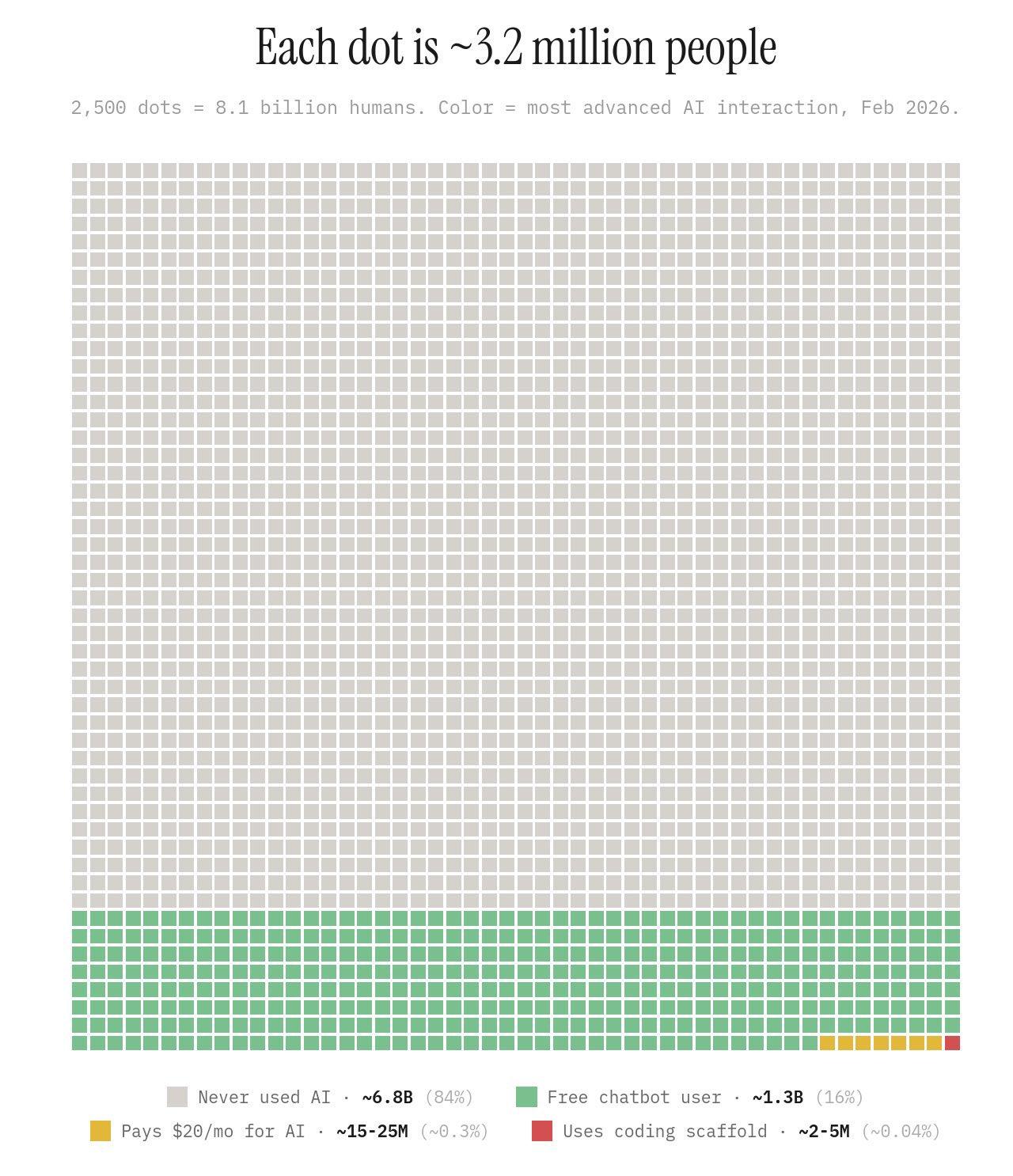
- ⬜️ 84% of humanity - about 6.8 billion people - have never opened ChatGPT, Gemini, Claude, Perplexity, or anything similar.
- 🟩 16% (≈1.3 billion) tried a free chatbot once or twice.
- 🟨 0.3% (≈15–25 million) pay for plans such as ChatGPT Plus, Claude Pro, or GitHub Copilot.
- 🟥 0.04% of all humans - are using AI to build on.
….. ZERO POINT ZERO FOUR PERCENT OF EVERYONE.
And you think this is a bubble?
☝️ The Chart That Made Me Stop Scrolling
There's a visualization that went semi-viral recently.
Each square is colored based on the most advanced way someone interacts with AI.
The claim it made was bold: roughly 84% of humans have never intentionally used AI.
And only a tiny sliver pays for tools or uses serious coding and agent workflows.
I get why it resonated.
Because in tech circles, AI feels like oxygen.
But step outside those circles, and you still meet plenty of sharp, capable people who haven't opened a chatbot even once.
I see it in conversations with business owners all the time.
Here's where it gets interesting, though.
Newer adoption numbers paint a different picture.
Over 1 billion people now use standalone GenAI tools every month.
That includes ChatGPT, Gemini, Claude, Perplexity, and others.
Depending on the dataset and how you define "active," that puts usage at roughly 12 -16% of everyone on Earth.
Picture a stadium with 50,000 seats.
Paid users of ChatGPT Plus, Claude Pro or Copilot would fill fewer than 15 seats.
Engineers running true agent workflows would take up only two.
TWO.
On the business side, estimates show 78 - 89% of companies use AI in at least one function, and around 71% report GenAI use in some form.
And then there's the agent layer.
In real telemetry data from Anthropic, roughly 49% of agent tool calls are code-related.
Most "real" agent use is still guarded by approvals and permissions.
So we've got broad adoption at the surface. And a very concentrated group doing the serious building underneath.
That gap between the two is where a lot of business advantage is going to come from in 2026.
And that's an 💸 opportunity 💸 you're in the perfect position to take right now.
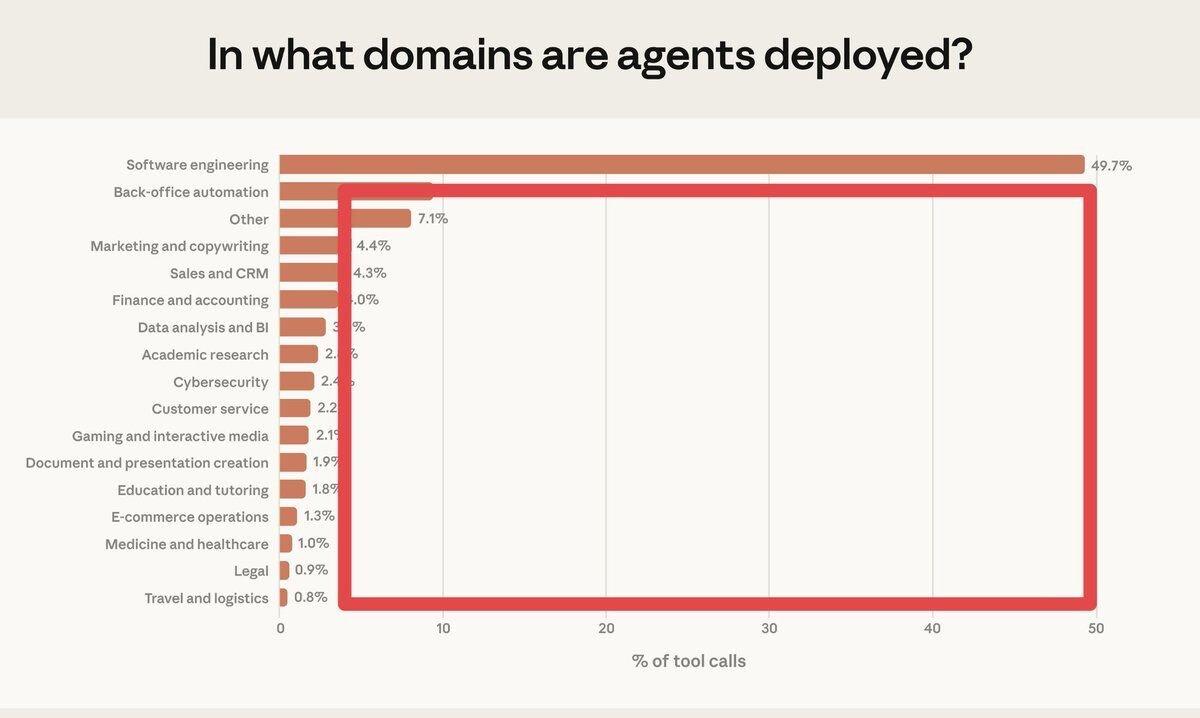
Anthropic gave us this chart for where agents are deployed.
And the circled square is your lane if you're looking for one.
Plenty of runway remains for builders, trainers, and consultants who can bridge these gaps.
Even with over a billion monthly users, there's a massive valley between "I asked a chatbot a question" and "AI is wired into how my work gets produced, reviewed, shipped, and measured."
That gap shows up in paid usage too.
Older estimates put paid subscribers for premium AI tools (the roughly $20/month tier) in the tens of millions.
Even if that number has grown since, it's still a small slice of the population.
This combination implies several things:
1️⃣ The public conversation is running ahead of reality.
In tech circles, AI feels saturated. Globally, it’s not even close. What feels “everywhere” in our bubble is still early-stage for most of the world.
2️⃣ The defaults are being set by a tiny group of early adopters.
How they instrument, supervise, and constrain agents today will quietly shape what “normal” looks like when adoption widens. Edge behavior now becomes standard practice later.
3️⃣ The growth ceiling is still enormous.
Even a 10x increase in paying users would represent a small slice of humanity. A 10x jump in advanced usage would still be niche. We’re not late, we’re watching the foundation being laid.
🏁 Why Software Is "Agent Country" Right Now
A lot of people chalk this up to developers loving new tools. That's part of it, sure.
But the bigger reason is structural.
Software is an environment where agents can succeed because the work is already set up in a way that makes AI safer.
Here's what software has that many other departments still lack.
- Everything important is already text and organized.
- Feedback is fast and blunt.
- Mistakes are usually reversible.
- Clear boundaries are easy to set.
Those are simple rules to enforce, and they give teams confidence to let agents operate.
The autonomy trend in the data is subtle and realistic. And honestly, it's encouraging.
Teams aren't saying, "Cool, AI, go run the company."
They're doing something much more mature.
They start with tight permissions.
They add approvals.
They keep runs short.
They watch what happens.
And then, over time, they increase autonomy in places where errors are cheap and visible.
That is how real systems get adopted.
💡 If You're Not in Software, This Still Applies to You
If you work in finance, sales, ops, HR, healthcare, legal, logistics, education, or marketing, please stay with me here.
This pattern matters for you too.
The lesson from the software world is straightforward: agents thrive in environments that are structured, logged, permissioned, and reversible.
So the practical question for your business becomes: where could you make work more versioned, more testable, and easier to roll back?
Yes, AI is spreading. Fast.
But the people and teams who move from casual prompts to consistent workflows to tool-using agents?
They're still early.
And that early window is where a lot of leverage sits for businesses willing to put in the work now.
👀 Ladies In San Diego - I'm Speaking In Your Town This Month
Excited to share that I'll be speaking at Energetics of Business Live in San Diego March 19th at the VIP day for this event, and I'd love for you to join me!
This isn't your typical business conference. EOB Live is focused on the energetics, the healing, and the deep inner work that's required to scale your business and uplevel your life.
My friend Erin has created exactly that and here's the highlights she shared with me:
✨ 2-3 days of transformation in sunny San Diego
✨ Incredible speakers (I'll be there!)
✨ 75+ women business owners healing together, networking, and building true connections that last a lifetime
✨ The kind of conversations where you finally feel "these people get me"
✨ Heart-centered entrepreneurs ready to expand into their next level
Interested in joining me? Here's the link 🔗
Use code BEMYGUEST to save 30% off tickets
Also, as a bonus, anyone who joins I'm throwing in a totally free 3 month membership to CTRL + ALT + BUILD, my private AI slack community so you can keep the momentum going with me.
Let's bring this opportunity in front of us all together.
🧩 Try This, This Week (10 Minutes)
Pick one recurring task and answer these three prompts. Write them down somewhere your team can see:
- What does "good output" look like? (One sentence. Keep it simple.)
- What's the review step? (Who checks it, and what are they checking for?)
- What's the rollback? (If it's wrong, what do we do?)
You'll be amazed how quickly this turns "AI curiosity" into "AI operations."
Three questions.
Ten minutes.
And suddenly, you have a framework your whole team can use.
P.S. I've got one VIP day spot for March left, and I'm reviewing applications.
// enjoyed.this.transmission
Get the next one in your inbox.
CTRL+ALT+BUILDTM ships every Tuesday - free forever, unsubscribe anytime.
// ps - there's a whole room behind this letter. Meet the community →