// transmission -
🎨 Who Gets to Be the Artist Now?
When photography showed up in the 1800s, painters panicked.
The story goes that one French painter saw an early photograph and declared that painting was dead.
It wasn’t.
What actually happened?
Painters stopped competing to “make it look exactly real.”
The camera won that fight.
Instead, they got creative.
They leaned into the thing a machine couldn’t do... light, feeling, point of view.
A lot of what we now call modern art (e.g., abstract) came out of that moment.
And as we know… realism didn't end.
In fact, painters, photographers, and filmmakers started inspiring each other and creating new forms of art.
I’ve been thinking about that story a lot lately.
Because the same panic is running through every podcaster, writer, designer, and video creator I talk to.
And honestly? Some of it is earned.
This week is all about what AI means for the people who make things.
The good, the part that stings, and where I think the real advantage lives.
Plus a quick look back at something we did for the first time. 👀
🎙️ AI Walked Into the Studio…
Creators are using AI and feeling more conflicted about it than ever.
Key Facts
- ⚡️ Speed Is Real - 93% of creators using creative AI say it helps them produce faster, per Adobe’s 2026 survey of 16,000+ creators 🔗
- ✂️ Output Still Needs You - 57% of those same creators say AI output needs moderate or heavy editing before it ships 🔗
- 🤫 Secret Contradiction - 46% of creators who dislike AI in other people’s work use it in their own 🔗
So if creators dislike AI, why are they using it?
🖐️ Where AI Is Actually Helping
Let’s start with the part nobody argues about.
The grunt work.
If you run a podcast, you know the list.
Cleaning up audio. Pulling clips. Writing show notes. Transcripts. Captions. Episode titles you rewrite nine times.
If you write, it’s the research rabbit holes.
The outline you can’t get started on.
The 14th draft of a book description.
None of that is the art.
It’s the stuff standing between you and the art.
That’s where AI shines right now.
Uppbeat’s creator report found that technical help like cleanup and captions was the most accepted use of AI among creators, followed by idea generation and research 🔗
Fully AI-generated content?
Almost nobody wants that for their own work.
So the line creators are drawing is pretty clear.
Help me make it. Don’t make it for me.
I agree with that line.
It’s the one I use for this newsletter.
AI helps me research, organize, and pressure-test.
The opinions, the stories, the “UGH 🤦” moments... those are mine.
😬 The Part That Stings
I’m not going to pretend this is all upside.
A University of Cambridge study surveyed published UK novelists.
59% knew their work had been used to train AI.
Almost none of them gave permission, and none of them got paid 🔗
Sit with that for a second.
You spend years writing a book.
It becomes training data for a tool that can now write in a style close to yours.
And you find out after the fact.
That’s a significant wound.
If you’re a writer and you feel angry about it, you’re not being dramatic.
And it explains that 46% number from the top.
A lot of creators are using tools they don’t fully trust, built in ways they don’t fully agree with, because the alternative feels like falling behind.
That’s an uncomfortable place to work from.
✋🏻 Who else feels a little of both?
🧭 Taste Is the Moat
Here’s where I land.
Go back to that 57% number.
More than half of creators say AI output needs human input before it’s good enough to publish.
That’s not a flaw in the tools.
That’s the job description of an artist.
AI can give you options. It can’t tell you which one is right.
Your taste.
Your timing.
Knowing which joke to cut.
Hearing a guest say something worth building a whole episode around.
Knowing a sentence is “correct” but dead on the page.
That’s the stuff people come back for.
And it’s the stuff AI makes more valuable.
Adobe found the same thing from the creator side.
85% said the final creative decision should always stay with the creator 🔗
Adobe sells creative AI tools, so they have skin in the game.
But that number is still telling.
Even the heaviest AI users want their hands on the wheel.
This brings me back to the painter story.
The painters didn’t win by out-photographing the camera.
They won by doubling down on what only a person could bring.
And being open to new ways of creating art.
Same move here.
👉 Whether you make podcasts, books, videos, or a business that runs on content, sit with these:
- What part of your creative process do you actually love doing? And what part do you just tolerate?
- If someone listened to your show or read your work with your name removed, what would tell them it was you?
- Where have you let AI make a choice that should have been yours?
- And if you’re honest, are you avoiding AI because of your values, or because you haven’t found a version of it that fits how you work?
📹 We Ran Our First Webinar
We just hosted our very first webinar to demo Casthouse, the most insane podcast-editing platform in existence (really).
Come test it out and see it for yourself.
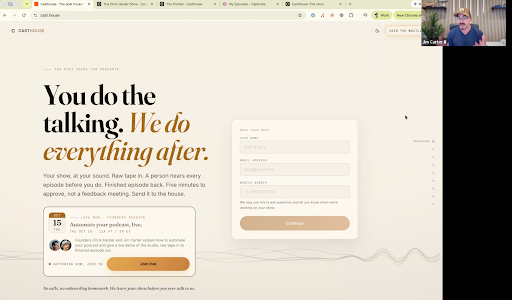
Thank you to everyone who showed up live, asked questions, and stuck around until the end.
We’re doing another one in two weeks, so get on the list by clicking here.
✅ Try This, This Week (It Only Takes 10 Minutes)
Grab a piece of paper.
Draw a line down the middle.
On the left, write every task in your creative process.
Every
single
one.
From idea to publish.
On the right, mark each one:
- 🎨 Mine - this is where my voice lives. AI doesn’t touch it.
- 🤝 Shared - AI can draft or suggest. I decide.
- 🤖 Hand it off - pure grunt work. Let AI take it.
Then pick ONE task from the “hand it off” column and try AI on it this week.
Just one.
See how it feels.
// enjoyed.this.transmission
Get the next one in your inbox.
CTRL+ALT+BUILDTM ships every Tuesday - free forever, unsubscribe anytime.
// ps - there's a whole room behind this letter. Meet the community →