// transmission -
🛰️ The SEO Death Zone
I've worked In tech now for 25 years.
And specifically in SEO for 12 of them.
Never has search traffic changed so dramatically.
Until now.
"We didn't change our content. Our rankings didn't budge. But our clicks… vanished."
Last week, a longtime client sent me a screenshot to review.
It was a traffic chart that looked like a ski slope.
I've heard that line so many times this year that it now feels like a script. And the numbers back it up.
This isn't a rough patch.
This is a reset of how people get answers, how attention moves, and who gets paid for it.
So let's talk about what changed, why it matters, and what you can do next.
Whether you're a founder, leader, or run a nonprofit – you need to know this about the complete change in SEO.
🎁 The SEO Collapse
AI summaries in search are swallowing clicks at record speed. SEO went from a steady growth channel to a risk you can't ignore.
Key Facts
- Dead End Search: 🔎 69% percent of Google searches now stop at the results page
- Organic Dip: 📉 The #1 organic position loses 34.5 percent of clicks when an AI Overview appears
- Huge Losses: 📰 News and How-To publishers have surrendered as much as 90% of their audiences
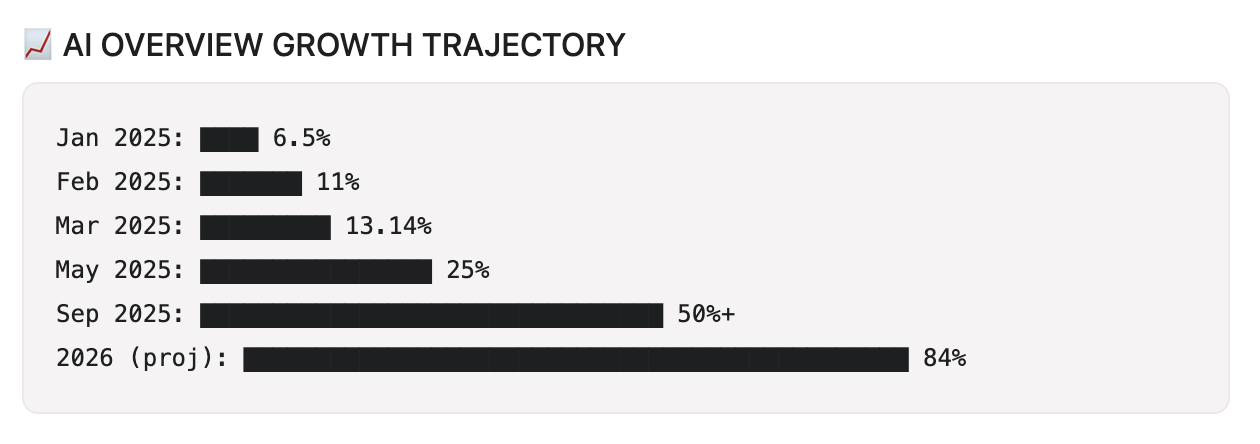
This chart looks at the estimated percentage of searches receiving AI Overviews.
And the speed of change caught everyone off guard.
This doesn't go back 4-5 years, it's looking at key jumps of months in THIS year alone.
In January 2025, AI Overviews appeared in just 6.5% of US searches.
By March, it was 13.14%.
And by September, more than half of searches showed an AI summary.
MORE. THAN. HALF.
That rollout reached about 1.5 billion people across 200+ countries in under two years. That is blistering adoption by any standard.
🥊 A Gut Punch (What Happened & Why)
The behavior shift is stark. When an AI Overview appears, only 8% of people click anything.
Without it, that number is 15%. Less than 1% click the sources cited inside the AI box.
Think about that for a second.
The AI answers.
People read it.
They leave.
No click. No visit. No chance to show them what you built.
The number one organic result loses 34.5% of its clicks on average. It drops from 7.3% to 2.6%.
These aren't edge cases anymore.
They're the center of search now.
Now here's the physical part almost nobody talks about.
When the AI box loads, it pushes the first blue link down about 1,600 pixels. That's roughly 151% of a phone screen height below the fold.
People don't scroll that far.
If you've spent years earning that top spot, it's still there… it's just outside of where most users look.
🌀 The Fallout Is Real
News publishers report 600 million fewer monthly visits year over year. Some independents lost 90% or more of their audience. Major news outlets are down 30% to 51%. CNN at 30%. The Sun at 51%.
Travel publishers? 78% saw declines. One third lost more than 90%.
DMG Media, which runs the Daily Mail and Metro, saw desktop click-through rates drop from 25% to 2.79%.
That's an 89% decline. 🤯
That's not a tweak. That's a cliff.
If you write tutorials, guides, or general Q&A content, pressure is highest.
An estimated 99.9% of informational keywords now trigger AI Overviews.
Yes. Ninety Nine Point Nine.
That includes how-to articles, educational content, and reference queries.
Entire categories that once fueled SEO strategies now resolve without a visit.
Klaudia Jaźwińska, a researcher at Columbia, summed up the worst part for publishers. She said if you opt out of AI Overviews, you opt out of Google Search entirely. There's no real middle lane. You stay in and bleed. Or you step out and stop.
Her work and commentary are worth checking out if you care about the policy side of this shift.
🖼️ The Big Picture
You get it.
The drop is substantial (and happening across industries.)
Here's the bigger pattern.
This isn't evolution. It's a transfer of value.
Let me pause and ask you three simple questions.
- First, if your organic traffic dropped 30% to 50% and stayed there, what would break first?
- Second, which parts of your content actually lead to revenue? And which pieces do you keep making just out of habit?
- Third, what customer questions can't be satisfied by a one-paragraph summary? What would make someone choose you anyway?

Deep breath.
We're good 😌
The purpose of all those stats is to make sure we're thinking clearly on the current state of events.
📖 Here's a Practical Playbook You Can Start This Week
BrightEdge reports that AI-driven referrals convert 5x - 23x better than ordinary clicks, yet they remain under 1% of total visits. High intent cannot replace missing volume.
Yet here's how you can respond & begin to maximize this change:
- Control your space. Email, SMS, podcasts, and private communities operate on your terms, not Google’s. Invite today’s readers to tomorrow’s conversation now.
- Offer what AI cannot. Personal stories, local nuance, humor, live demos, and video walkthroughs resist summary. Lean hard into humanity.
- Deploy structured data. Citation links draw few clicks, yet semantic markup still earns visibility and authority. Every schema tag is a small insurance policy.
- Audit platform risk. Model a 50% traffic cut against budget, product mix, and partnerships, then shore up weak points before the next algorithm tweak.
🧪 Experiments I'm Running (Steal These)
I've been testing these approaches across startups, nonprofits, and Fortune 500 teams.
None require a budget you can't afford.
All respect the new reality.
1️⃣ Create AI-resistant content
Build pieces that can't be summarized without losing the point. Original data. Pricing benchmarks. Calculators. City-level guides. Teardown video deep dives. Real customer playbooks. Opinionated points of view.
Ask yourself if a one-paragraph answer could replace this.
If yes? Rethink it.
2️⃣ Shift more effort to brand demand
Run small, repeatable campaigns that make people search for you by name. Think webinars with partner brands. Lightweight challenges. Customer-led panels. Weekly short videos.
Can you publish one thing per week that your audience would forward to a friend?
3️⃣ Replace some blogs with tools
A free budget planner. An ROI calculator. Checklists that export to Notion. A map of local resources. A simple API demo.
Tools earn links, email opt-ins, and repeat visits far more than yet another generic guide.
4️⃣ Build first-party pipelines you own
Email. SMS. A private community. A fast "what's new" page.
Offer one clearly valuable opt-in that delivers weekly. Keep it punchy, consistent, and useful.
One great email beats ten bland posts.
5️⃣ Target post-AI queries
Look for searches where people must click. Vendor evaluations with brand names. "Near me" service intent. Address-based info. Local policies. Downloads. Templates. Calculators (again). Compare XYZ versus 123 and so on..
Dodge AI Overviews and keep solid intent.
6️⃣ Boost on-page conversion by 20% to 30%
If volume drops, you can still win by converting more.
Improve speed.
Simplify forms.
Add proof near calls to action.
Use exit-intent offers that are actually helpful.
Test a one-question quickstart flow.
Conversion is king.
7️⃣ Add structured data and content freshness
It won't fix the core shift. But it helps your eligibility for rich results and keeps you competitive in the slices where clicks remain.
In a sea of content, make yours a breath of fresh air.
🎙️ ICYMI: Podcast: AI in the Social Impact Sector
Last week, I mentioned I joined Mike Spear on the Cause & Purpose podcast to talk about something close to my heart: how AI can support nonprofits and mission-driven teams who are often slower to adopt new tech.
We touched briefly on my own story, but the real focus is on Altruous and the practical ways AI can amplify human judgment - from smarter evaluation systems to real examples like facilitating $10M+ in crypto donations.
I share a LOT of wonderful perspectives, some very personal things you probably have never heard me talk about, but also we reverse the roles and I interview Mike on the AI side too.
✅ If you work in the NGO space or want a clearer view of how AI can actually help teams doing meaningful work, this episode is a great place to start.
🎯 Spend a VIP day with me in Newport Beach!
I'm now offering limited VIP days. Something I've never done before, but has been on my heart now for years.
→ Spend the day with me in gorgeous Newport Beach, CA.
→ Full day workshop with AI strategies on your business in a private workspace, guided by me.
→ Lunch & Dinner provided.
→ Full overview, recordings and breakdown delivered in 48hrs.
This would be the single most focused, and fast-tracked way to ramp up AI into your business I can offer.
We can even work on your impact-driven idea together.
Sound great?
✌️ Your Move
Search made the open web feel infinite. AI is making answers feel instant. Those two ideas don't play by the same rules.
You don't have to win every generic query. You do have to be the obvious choice for the people you care about most.
That shift can feel scary. It can also feel freeing. It pushes all of us to build things worth returning to and relationships we actually own.
If this hit home, I want to hear your story.
What's working?
What challenges are you facing?
Tell me what you think. I read every response.
P.S. Our community is growing and we're welcoming new members in weekly. Join us 🔗
// enjoyed.this.transmission
Get the next one in your inbox.
CTRL+ALT+BUILDTM ships every Tuesday - free forever, unsubscribe anytime.
// ps - there's a whole room behind this letter. Meet the community →