🤖 Left the Party to Check His Agents?
This is going to date me, but follow along.
Remember when texting felt weird?
When ordering food through an app seemed excessive?
When storing files in "the cloud" sounded risky?
The moment something stops feeling strange, adoption explodes.
Entire industries reorganize around the new normal.
Last week I sat down with my mentor and friend Lori Harder on her podcast, and there was one thing that I kept coming back to in our conversation…
Agents.
You've heard me say before that agents are the future of work.
The wild part is that society is getting used to it faster than most people realize.
The early movers are already ahead. And you can start today.
🤖 Agents Are the New Normal
A short story from VC Nikunj Kothari shows how quickly things are changing.
Key Facts
⏱️ 40 mins vs 4–6 weeks – We need to stop measuring time in human effort hours
📈 Task range keeps expanding – agents add longer workflows every quarter.
💵 Seat pricing wobbles – when the “worker” is software, charging per human login stops matching reality. I'll explain.

A venture capitalist named Nikunj Kothari, partner at FPV Ventures (and previously at Khosla Ventures), posted a simple observation:
His friend left a party at 9:30pm on a Saturday night.
Not because he was tired.
Not because he felt sick.
Because he wanted to get back to his agents.
And nobody questioned it.
Read that again.
Nobody questioned it.
Instead, it landed like: "Yep. Makes sense."
That's a cultural checkpoint.
At least in the Bay Area, but why wouldn't we base what's coming off a location where it's already happening?
Think about what happened with email. Then smartphones. Then Slack. At first the behavior seems odd.
Then it becomes normal.
Then it becomes expected.
Agents are hitting that same curve. Fast.
This matters because culture always shifts before the money does.
🚧 The Real Bottleneck: Serialization.
Asked Claude how long a project would take, and it may estimate 4 to 6 weeks.
Meanwhile, it will probably finish in 40 minutes.
Now, that isn't because a model is some magical worker bee.
It's because Claude pattern-matches a human timeline.
Planning calls. Status updates. Waiting for feedback. Context switching.
And… Weekends.
The slow drip of attention that comes with being a person who has a body and a life and obligations pulling at them from every direction.
You know, being a human and living a full life.
The frustrating part isn't human speed… it's human serialization.
You can only hold one conversation at a time, work on one thing at a time, and you stop for 8 hours every day to sleep.
Not to mention wellness, leisure, family, friends…
👉 You can only do so much.👈
That's the punchline. And it's a big one.
For all of human history, we've been trapped in a one-thread-at-a-time operating system.
You finish one thing, then you start the next. Or you try to juggle and everything suffers.
Agents don't live there.
They can run multiple work streams in parallel without getting tired, without losing focus, without needing a meeting to feel aligned.
They just keep going…
And that's why normalizing Agents in your business is the smartest move you can make right now.
💰 Let's Talk Money
Specifically, per-seat software pricing, which only works when humans sit in those seats.
If an agent handles 80% of your support tickets, why would you pay per support rep? Why not pay per ticket resolved? Or by average time to close?
I'm watching this shift happen in real rooms right now:
🫰 Executives compare total cost differently.
They look at "software plus human labor" versus "guaranteed outcome." When the outcome wins on quality, speed, and cost, it gets the budget.
🔀 Pricing models are shifting.
Per resolved ticket instead of per support seat.
Per qualified lead instead of per sales development rep.
Per campaign shipped instead of per marketing license
Even if you don't work in software, this concept should become clear.
Because the same idea applies to your business, and your competitors.
Let's look at how we can make this actionable.
Make this your new standard.
Create agents like you would hire direct reports. Give them company research, competitor analysis, data cleaning, or outreach prep. Let them all run at the same time. Check their work like you would with any teammate.
Start treating them like junior employees who need:
- Clear direction
- A defined finish line
- Checkpoints
- Quality control
Spin up agents like direct reports. That framing matters because it forces you to act like a leader.
You assign work in parallel.
You check the output.
You refine the instruction.
You ship the result.
If you've ever managed people, managed projects, or even run a household, you already have the muscles for this.
The difference now is that the person you're delegating to doesn't need sleep, doesn't call in sick, and can hold ten tasks in their head without dropping a single one.
That said, they still need you.
Your understanding of what "good" looks like for your specific business.
Without that, they'll produce work that looks polished but misses the point.
So your role as the leader actually becomes more important, not less.
What would you change this week if "one thing at a time" wasn't your limit anymore?
🏆 Where Early Adopters Win
One of the most practical ways to think about this is that your 24 hours now has three blocks.
→ Active work (about 8 hours): the stuff that requires you.
- Relationships, decisions, taste, hard conversations, direction. The things that make your business yours. And that coveted block of core productivity every day. Leverage.
→ Agent-supervised work (about 8 hours): agents running while you bounce between real life and check-ins.
- You're present but not grinding. You're reviewing, adjusting, approving. You're getting work done for you while you prep for your day, between tasks, while the family eats dinner, and even a little bump before bed.
→ Agent-autonomous work (about 8 hours): overnight runs.
- Research, drafts, code, cleanup, analysis. Work that's ready for your review when you wake up with coffee in hand. In other words, new time for productivity that never really needed to be you anyhow.
This is why early adopters feel like they found extra time.
I think about this a lot because I've worked with business owners for years who are brilliant, driven, and still feel like they're drowning.
The reason is almost never laziness or lack of skill.
It's that they're one person trying to run twelve work streams sequentially.
Agents break that pattern wideeeee open. 💥
And I'm finding more and more opportunities for the supervised and autonomous work now every day.
It's life-giving.
Even with everything I know about AI, tech, automations and systems, this new pattern is more approachable and fruitful just in the last month than it's been my entire professional career.
And we're only getting better.
Looking to start somewhere? A favorite of mine is Manus - for the ease and simplicity to connect your systems together and tune it for what you want.
Try something. Today.
Don't believe me?
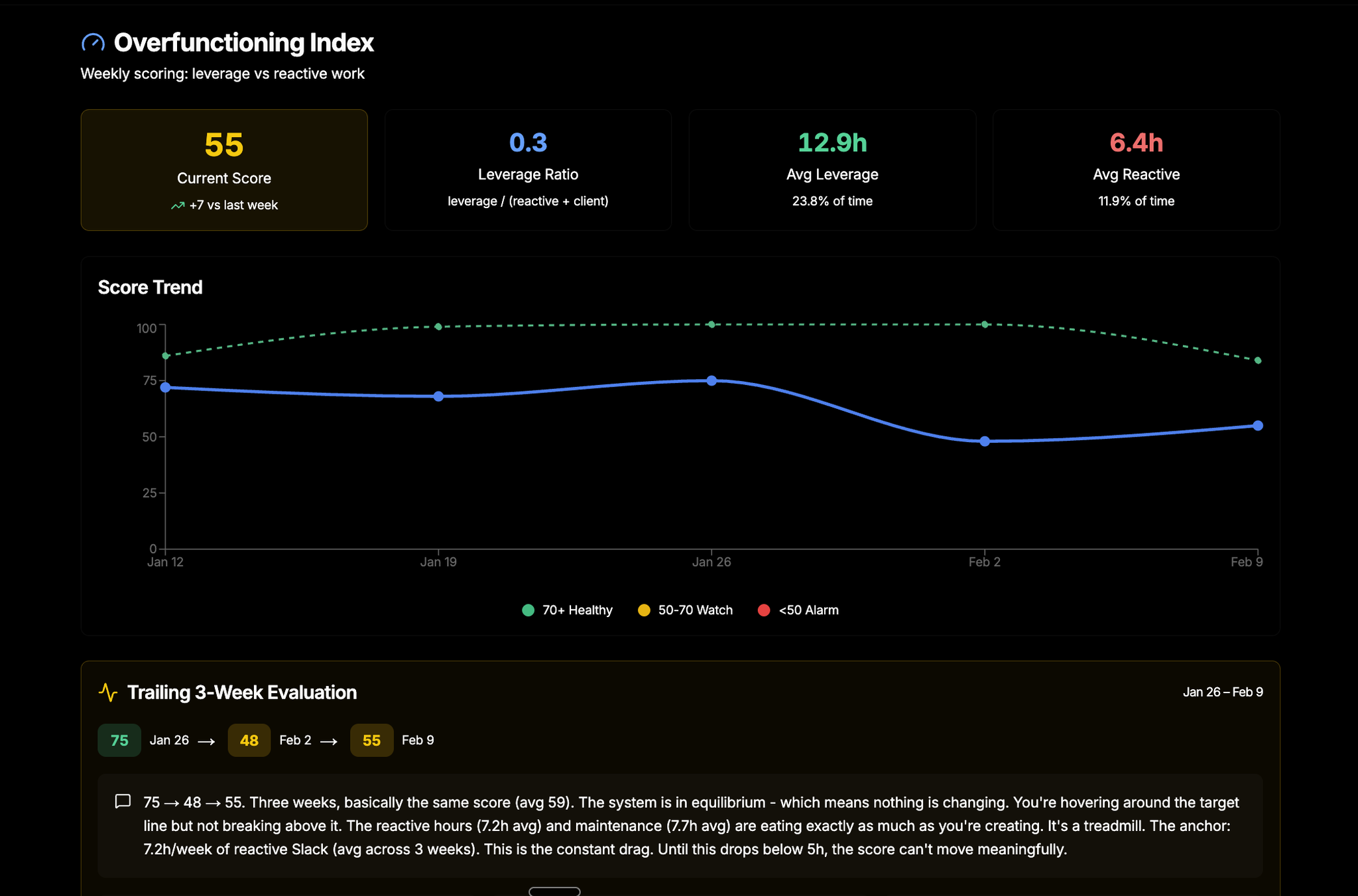
Allow me to introduce you to my Overfunctioning Index. A personal dashboard my agent built me.
Remember those two new buckets I talked about, Agent-autonomous and Agent-supervised work?
Last Friday night I tasked my agent (Openclaw) to run a deep analysis overnight of where I'm over-functioning, being too reactive, losing time and losing leverage and build me a dashboard of the data.
It has access to my Slack, Asana, Email, Notes, Client projects, and just about everything I spend my days on.
By morning (Agent-autonomous) I woke up to a dashboard that had a full graph, one week of data, lists, and some suggestions of where it saw my days going to hell.
It was good, not great.
I then spent some time Saturday between other things (like before getting in the shower, out for a walk, waiting for food) etc steering it for updates (Agent-supervised) like:
- Update the evaluation to look for X, Y, Z (to sharpen the logic)
- Give me a trend line showing what the week could look like had I done less reactive work
- Back process the rest of the weeks this year
- Look for regression, progression, and coach me on my bind spots
Now I have a fully functioning, always updating personal dashboard showing me what I want, and how to maximize my day.
Let me make one thing clear. This wasn't extra work. This was genuinely fun, chatting with AI watching it come alive.
It started with a prompt, it required connecting data and outlining the objective, and took some tuning.
But the most important fact?
I didn't write a line of code, build an algorithm, deal with connecting services, come up with charts, none of it.
This is no longer the future.
This is what's waiting for you.
And you just have to be brave enough to be ok with it feeling strange, and lean into it.
💡 Ask Yourself This
Where is your business still stuck waiting on one person's inbox, one person's memory, one person's bandwidth?
If your competitor starts running 3 to 5 projects in parallel with the same headcount, what changes for you?
What would you hand off first if you trusted an agent like a jr. employee?
Research?
Reporting?
Drafting?
Scheduling?
Lead follow-up?
Tell me which agent you're going to put to work tonight. I read every email and I'd love to share the best examples.
P.S. We filled all the lifetime spots for QuickSign & you can still try it totally for free - we're launching on Product Hunt soon and I can't want to share that with you!
P.P.S. I'm opening two VIP day spots for March
Enjoy this edition?
Get CTRL+ALT+BUILDTM delivered to your inbox every week.